There are a lot of questions right now regarding the real estate market as we head into 2022. The forbearance program is coming to an end and mortgage rates are beginning to rise.
With all of this uncertainty, anyone with a megaphone – from the mainstream media to a lone blogger – has realized that bad news sells. Unfortunately, we’ll continue to see a rash of troublesome headlines over the next few months. To make sure you aren’t paralyzed by a headline, turn to reliable resources for a look at what to expect from the housing market next year.
There are already alarmist headlines starting to appear. Here are two recent topics you may have seen in the news.
1. Foreclosures Are Spiking Today
There are a number of headlines circulating that call out the rising foreclosures in today’s real estate market. Those stories focus on an overly narrow view on that topic: the current volume of foreclosures compared to 2020. They emphasize that we’re seeing far more foreclosures this year compared to last.
That seems rather daunting. However, though it’s true foreclosures have been up over the 2020 numbers, it’s important to realize that there were virtually no foreclosures last year because of the forbearance plan. If we compare this September to September of 2019 (the last normal year), foreclosures were down 70% according to ATTOM.
Even Rick Sharga, an Executive Vice President of the firm that issued the report referenced in the above article, says:
“As expected, now that the moratorium has been over for three months, foreclosure activity continues to increase. But it's increasing at a slower rate, and it appears that most of the activity is primarily on vacant and abandoned properties, or loans in foreclosure prior to the pandemic.”
Homeowners who have been impacted by the pandemic are not generally the ones being burdened right now. That’s because the forbearance program has worked. Ali Haralson, President of Auction.com, explains that the program has done a remarkable job:
“The tsunami of foreclosures many feared in the early days of the pandemic has not materialized thanks in large part to the swift and decisive foreclosure protections put in place by government policymakers and the mortgage servicing industry.”
And the government is still making sure homeowners have every opportunity to stay in their homes. Rohit Chopra, the Director of the Consumer Financial Protection Bureau (CFPB), issued this statement just last week:
“Failures by mortgage servicers and regulators worsened the impact of the economic crisis a decade ago. Regulators have learned their lesson, and we will be scrutinizing servicers to ensure they are doing all they can to help homeowners and follow the law.”
2. Rising Mortgage Rates Will Slow the Housing Market
Another topic that’s generating frequent headlines is the rise in mortgage rates. Some people are expressing concern that rising rates will negatively impact the housing market by causing home sales to dramatically decline. The resulting headlines are raising unneeded alarm bells. To counteract those headlines, we need to take a look at what history tells us. Looking at data over the last 20 years, there’s no evidence that an increase in rates dramatically forces sales to come to a halt. Nor does home price appreciation come to a screeching stop. Let’s look at home sales first:The last three times rates increased (shown in the graph above in red), sales (depicted in blue in the graph) remained rather consistent. It’s true that sales fell rather dramatically from 2007 through 2010, but mortgage rates were also falling at the time. The next two instances showed no meaningful drop in sales.
Now, let’s take a look at home price appreciation (see graph below):Again, we see that a rise in rates didn’t cause prices to depreciate. Outside of the years following the crash, prices continued to appreciate, just at a slower rate.
Bottom Line
There’s a lot of misinformation out there. If you want the best advice on what’s happening in the current housing market, let’s connect.
If you’re looking to buy or sell a house, chances are you’ve heard talk about today’s rising home prices. And while this increase in home values is great news for sellers, you may be wondering what the future holds. Will prices continue to rise with time, or should you expect them to fall?
To answer that question, let’s first understand a few terms you may be hearing right now.
Appreciation is an increase in the value of an asset.
Depreciation is a decrease in the value of an asset.
Deceleration is when something happens at a slower pace.
It’s important to note home prices have increased, or appreciated, for 114 straight months. To find out if that trend may continue, look to the experts. Pulsenomics surveyed over 100 economists, investment strategists, and housing market analysts asking for their five-year projections. In terms of what lies ahead, experts say the market may see some slight deceleration, but not depreciation.
Here’s the forecast for the next few years:As the graph above shows, prices are expected to continue to rise, just not at the same pace we’ve seen over the last year. Over 100 experts agree, there is no expectation for price depreciation. As the arrows indicate, each number is an increase, which means prices will rise each year.
Bill McBride, author of the blog Calculated Risk, also expects deceleration, but not depreciation:
“My sense is the Case-Shiller National annual growth rate of 19.7% is probably close to a peak, and that year-over-year price increases will slow later this year.”
“. . . home price appreciation is on the cusp of flipping to a deceleratingtrend.”
A recent article from realtor.com indicates you should expect:
“. . . annual price increases will slow to a more normal level, . . .”
What Does This Deceleration Mean for You?
What experts are projecting for the years ahead is more in line with the historical norm for appreciation. According to data from Black Knight, the average annual appreciation from 1995-2020 is 4.1%. As you can see from the chart above, the expert forecasts are closer to that pace, which means you should see appreciation at a level that’s aligned with a more normal year.
If you’re a buyer, don’t expect a sudden or drastic drop in home prices – experts say it won’t happen. Instead, think about your homeownership goals and consider purchasing a home before prices rise further.
If you’re a seller, the continued home price appreciation is good news for the value of your house. Work with an agent to list your house for the right price based on market conditions.
Bottom Line
Experts expect price deceleration, not price depreciation over the coming years. Let’s connect to talk through what’s happening in the housing market today, where things are headed, and what it means for you.
There’s a well-known economic theory – the law of supply and demand – that explains what’s happening with prices in the current real estate market. Put simply, when demand for an item is high, prices rise. When the supply of the item increases, prices fall. Of course, when demand is very high and supply is very low, prices can rise significantly.
Understanding the impact both supply and demand have can provide the answers to a few popular questions about today’s housing market:
Why are prices rising?
Where are prices headed?
What does this mean for homebuyers?
Why Are Prices Rising?
According to the latest Home Price Insights report from CoreLogic, home prices have risen 18.1% since this time last year. But what’s driving the increase?
Recent buyer and seller activity data from the National Association of Realtors (NAR) helps answer that question. When we take NAR’s buyer activity data and compare it to the seller traffic during the same timeframe, we can see buyer demand continues to outpace seller activity by a wide margin. In other words, the demand for homes is significantly greater than the current supply that’s available to buy(see maps below):This combination of low supply and high demand is what’s driving home prices up. Bill McBride, author of the Calculated Risk blog, puts it best, saying:
“By some measures, house prices seem high, but the recent price increases make sense from a supply and demand perspective.”
Where Are Prices Headed?
The supply of homes for sale will greatly affect where prices head over the coming months. Many experts forecast prices will continue to increase, but they’ll likely appreciate at a slower rate.
Buyers hoping to purchase the home of their dreams may see this as welcome news. In this case, perspective is important: a slight moderation of home prices does not mean prices will depreciate or fall. Price increases may occur at a slower pace, but experts still expect them to rise.
Five major entities that closely follow the real estate market forecast home prices will continue appreciating through 2022 (see graph below):
What Does This Mean for Homebuyers?
If you’re waiting to enter the market because you’re expecting prices to drop, you may end up paying more in the long run. Even if price increases occur at a slower rate next year, prices are still projected to rise. That means the home of your dreams will likely cost even more in 2022.
Bottom Line
The truth is, high demand and low supply are what’s driving up home prices in today’s housing market. And while prices may increase at a slower pace in the coming months, experts still expect them to rise. If you’re a potential homebuyer, let’s connect today to discuss what that could mean for you if you wait even longer to buy.
Every Thursday, Freddie Mac releases the results of their Primary Mortgage Market Survey which reveals the most recent movement in the 30-year fixed mortgage rate. Last week, the rate was announced as 3.01%. It was the first time in three months that the mortgage rate surpassed 3%. In a press release accompanying the survey, Sam Khater, Chief Economist at Freddie Mac, explains:
“Mortgage rates rose across all loan types this week as the 10-year U.S. Treasury yield reached its highest point since June.”
The reason Khater mentions the 10-year U.S. Treasury yield is because there has been a very strong relationship between the yield and the 30-year mortgage rate over the last five decades. Here’s a graph showing that relationship:The relationship has also been consistent throughout 2021 as evidenced by this graph:The graph also reveals the most recent jump in mortgage rates was preceded by a jump in the 10-year Treasury rate (called out by the red circles).
“There are a number of economic factors that impact Treasury yields, such as interest rates, inflation, and economic growth.”
Since there are currently concerns about inflation and economic growth due to the pandemic, the Treasury yield spiked last week. That spike impacted mortgage rates.
What Does This Mean for You?
Khater, in the Freddie Mac release mentioned above, says:
“We expect mortgage rates to continue to rise modestly which will likely have an impact on home prices, causing them to moderate slightly after increasing over the last year.”
Nadia Evangelou, Senior Economist and Director of Forecasting for the National Association of Realtors (NAR), also addresses the issue:
“Consumers shouldn't panic. Keep in mind that even though rates will increase in the following months, these rates will still be historically low. The National Association of REALTORS forecasts the 30-year fixed mortgage rate to reach 3.5% by mid-2022.”
Bottom Line
Forecasting mortgage rates is very difficult. As Mark Fleming, Chief Economist at First American, once quipped:
“You know, the fallacy of economic forecasting is don't ever try and forecast interest rates and or, more specifically, if you're a real estate economist mortgage rates, because you will always invariably be wrong.”
That being said, if you’re either a first-time homebuyer or a current homeowner thinking of moving into a home that better fits your current needs, keep abreast of what’s happening with mortgage rates. It may very well impact your decision.
Are you looking to buy a home? If so, we’ve got good news for you.
While there’s no denying the housing market is having a great year, many of the headlines are focused on the perks for sellers. But what about buyers today? As a buyer, you’re likely braving bidding wars and weighing low mortgage rates versus price appreciation as you search for your dream home. If you find yourself a bit discouraged, hear this: there are clear signs buyers may have more opportunities this fall.
According to realtor.com, the sweet spot for buyers is just around the corner. In a recent study, experts analyzed housing market trends by looking at data from the past several years. When applied to the current market, experts determined the ideal week to buy a home this year. The research says:
“Nationally, the best time to buy in 2021 is the week of October 3-9. This week historically has shown the best balance of market conditions that favor buyers.”
So, what’s that mean for you? If you’re looking to buy a home, there’s a golden window of opportunity coming. Here’s what you can expect from that week.
Increased Housing Supply
The number of homes available for sale should increase. According to realtor.com, you can expect to see more new listings come to market the week of October 3. The findings estimate we’ll see roughly 17.6% more homes available than we saw at the start of the year.
This means you’ll have more options to choose from which should be a welcome relief in a market with tight housing supply.
Fewer Bidding Wars
With more homes available, you should also see a slight decline in the number of bidding wars. Having more options means buyers may not be competing as intensely for the homes on the market because there are more choices to go around.
This means when you write an offer, you may have less competition and a better chance of being the top bid. Just remember, it’s still important to come in with a strong offer.
Adjusted Homes Prices
As we move into the end of the year, the findings from realtor.com note this week may also be one of the peak weeks for price reductions in 2021. Historically the data shows an average of 7.0% of homes have a price reduction that week. Why? When housing supply ticks up, sellers need to look for other ways to make their house stand out.
This means, while home prices are still appreciating overall, you may see some homes with price adjustments from eager sellers. The process of closing a house takes time. To close before end of year, sellers may be more motivated this October.
Bottom Line
If you’re in the market for a home, don’t lose steam now. Data shows early October may give you the long-awaited opportunity to find the home of your dreams. Let’s connect so you have a trusted ally and advisor to help keep you motivated so you can find the perfect home for you.
In today’s sellers’ market, standing out as a buyer is critical. Multi-offer scenarios and bidding wars are the norm due to the low supply of houses for sale and high buyer demand. If you’re buying this fall, you’ll want every advantage, especially when you’ve found the home of your dreams.
Below are five things to keep in mind when it’s time to make an offer.
1. Know Your Budget
Knowing your budget and what you can afford is critical to your success as a homebuyer. The best way to understand your numbers is to work with a lender so you can get pre-approved for a loan. As Freddie Macputs it:
“This pre-approval allows you to look for a home with greater confidence and demonstrates to the seller that you are a serious buyer.”
Showing sellers you’re serious can give you a competitive edge. It enables you to act quickly when you’ve found your perfect home.
2. Be Prepared To Move Fast
Speed and the pace of sales are contributing factors to today’s competitive housing market. According to the latest Existing Home Sales Report from the National Association of Realtors (NAR), the average home is on the market for just 17 days. As the report notes:
“Eighty-nine percent of homes sold in July 2021 were on the market for less than a month.”
When homes are selling fast, staying on top of the market and moving quickly are key. After you’ve worked with your agent to find the home that suits your needs, they’ll help you put together and submit your best offer as soon as possible.
3. A Real Estate Professional Can Lead You to Victory
No matter what the housing market looks like, rely on a trusted real estate advisor. As Freddie Macsays:
“The success of your homebuying journey largely depends on the company you keep. . . . be sure to select experienced, trusted professionals who will help you make informed decisions and avoid any pitfalls.”
Agents are experts in the local real estate market. They have insight into what's worked for other buyers in your area and what sellers may be looking for in an offer. It may seem simple, but catering to what a seller may need can help your offer stand out.
4. Craft a Strong, Fair Offer
In the past, offering at or near the asking price was enough to make your offer appealing to sellers. In today’s market, that’s often not the case. According to the latest Realtors Confidence Index from NAR, 50% of offers are above the list price.
In such a competitive market, emotions and prices can run high. Having an agent to help craft a strong, fair offer is critical in these situations. Your agent can help you understand:
The market value of the home
Recent sales trends in the area
Current buyer demand
5. Understand the Seller’s Needs, but Resist Waiving Certain Contingencies
When crafting an offer, you’ll want to keep both your best interest and the interest of the seller in mind. Your trusted real estate advisor will help you consider which levers you could pull, including contract contingencies (conditions you set that the seller must meet for the purchase to be finalized). Of course, there are certain contingencies you don’t want to give up, like the home inspection.
“Resist the temptation to waive the inspection contingency, especially in a hot market or if the home is being sold ‘as-is’, which means the seller won’t pay for repairs. Without an inspection contingency, you could be stuck with a contract on a house you can’t afford to fix.”
Bottom Line
Today’s competitive housing market makes it more important than ever to make a strong offer on a home. Let’s connect to make sure your offer rises to the top.
Even though experts agree there’s no chance of a large-scale foreclosure crisis, there are a number of homeowners who may be coming face-to-face with foreclosure as a possibility. And while the overall percentage of homeowners at risk is decreasing with time (see graph below), that’s little comfort to those individuals who are facing challenges today.If you haven’t taken advantage of the forbearance period, it may be time to research and understand your options. It starts with knowing what foreclosure is. Investopedia defines it like this:
“Foreclosure is the legal process by which a lender attempts to recover the amount owed on a defaulted loan by taking ownership of and selling the mortgaged property. Typically, default is triggered when a borrower misses a specific number of monthly payments . . .”
The good news is, there are alternatives available to help you avoid having to go through the foreclosure process, including:
Reinstatement
Loan modification
Deed-in-lieu of foreclosure
Short sale
But before you go down any of those paths, it’s worth seeing if you have enough equity in your home to sell it and protect your investment.
Understand Your Options: Sell Your House
Equity is the difference between what you owe on the home and its market value based on factors like price appreciation.
In today’s real estate market, many homeowners have far more equity in their homes than they realize. Over the last year, buyer demand has been high, but housing supply has been low. That’s led to a substantial increase in home values. When prices rise, so does the amount of equity you have in your house.
According to CoreLogic, on average, homeowners gained $33,400 in equity over the last 12 months, and the average equity on mortgaged homes is now $216,000 (see map below):So, what does that mean for you? Over the past year, chances are your home’s value and therefore your equity has risen dramatically. If you’ve been in your home for a while, the mortgage payments you’ve made over time chipped away at the balance of your loan. If your home’s current value is higher than what you still owe on your loan, you may be able to use that increase to your advantage.
Frank Martell, President and CEO of CoreLogic,elaborates on how equity can help:
“Homeowner equity has more than doubled over the past decade and become a crucial buffer for many weathering the challenges of the pandemic. These gains have become an important financial tool and boosted consumer confidence in the U.S. housing market.”
Don’t Go at It Alone – Lean on Experts for Advice
To find out what your house is worth in today’s market, work with a local real estate professional. We’ll be able to give you an estimate of what your house could sell for based on recent sales of similar homes in your area. Since home prices are still appreciating, you may be able to sell your house to avoid foreclosure.
If you find out that you have to pursue other options, your agent can help with that too. We’ll be able to connect you with other professionals in the industry, like housing counselors who can look into your unique situation and offer advice on next steps if selling isn’t the best alternative.
Bottom Line
If you’re a homeowner facing hardship, let’s connect to explore your options and see if you can sell your house to avoid foreclosure.
It’s economy 101 – when supply is low and demand is high, prices naturally rise. That’s what’s happening in today’s housing market. Home prices are appreciating at near-historic rates, and that’s creating some challenges when it comes to home appraisals.
In recent months, it’s become increasingly common for an appraisal to come in below the contract price on the house. Shawn Telford, Chief Appraiser for CoreLogic, explains it like this:
“Recently, we observed buyers paying prices above listing price and higher than the market data available to appraisers can support. This difference is known as ‘the appraisal gap . . . .’”
Why does an appraisal gap happen?
Basically, with the heightened buyer demand, purchasers are often willing to pay over asking to secure the home of their dreams. If you’ve ever toured a house you’ve fallen in love with, you understand. Once you start to picture yourself and your furniture in the rooms, you want to do everything you can to land the property, including putting in a high offer to try to beat out other would-be buyers.
When the appraiser comes in, they look at things a bit more objectively. Their job is to assess the inherent value of the home, so they’re going to study the facts. Dustin Harris, Appraiser Coach, drives this point home:
“It’s important for everyone to understand that the appraiser’s job in the end is to remain that unbiased third party, to truly tell the client what that home is worth in the current market, regardless of what decisions have been made on the price side of things.”
In simple terms, while homebuyers may be willing to pay more, appraisers are there to assess the market value of the home. Their goal is to make sure the lender isn’t loaning more money than the home is worth. It’s objective, rather than emotional.
In a highly competitive market like today’s, having a discrepancy between the two numbers isn’t unusual. Here’s a look at the increasing rate of appraisal gaps, according to data from CoreLogic (see graph below):
What does this mean for you?
Ultimately, knowledge is power. The best thing you can do is understand appraisal gaps may impact your transaction if you’re buying or selling. If you do encounter an appraisal below your contract price, know that in today’s sellers’ market, the most common approach is for the seller to ask the buyer to make up the difference in price. Buyers, be prepared to bring extra money to the table if you really want the home.
Above all else, lean on your real estate agent. Whether you’re a buyer or seller, your trusted advisor is your ally if you come up against an appraisal gap. We’ll help you understand your options and handle any additional negotiations that need to happen.
Bottom Line
In today’s real estate market, it’s important to stay informed on the latest trends. Let’s connect so you have an ally to help you navigate an appraisal gap to get the best possible outcome.
Becoming financially secure is an important goal for many people today, but some don’t realize just how much homeownership can help them achieve that dream. A recent report, The Journey Toward Financial Freedom, surveys Americans about their perspective on financial wellness and their goals. It shows there may be a significant misconception about the role owning a home plays in building wealth:
“Home ownership is one of the indicators Americans say is least connected to financial health."
Two major personal wealth goals – homeownership and net worth – work hand-in-hand. Below are just a few reasons why, if you’re looking for financial security, homeownership should be a top priority.
Homeownership Is an Important Cornerstone of Building Wealth
Every three years, the Federal Reserve releases the Survey of Consumer Finances which highlights the difference in wealth between homeowners and renters. The graph below shows the findings across the previous surveys including the latest data (2019), and the results are staggering:As the graph illustrates, the gap between homeowners and renters continues to widen. That’s because homeownership contributes massively to an individual’s overall net worth. Odeta Kushi, Deputy Chief Economist at First American, highlights this idea:
“. . . between 2016 and 2019, housing wealth was the single biggest contributor to the increase in net worth across all income groups . . . .”
When we look even closer at the most recent data from 2019, the average homeowner’s net worth is more than40 times greater than that of the average renter (see graph below):The gap exists in large part because homeowners build equity as their home appreciates in value and they pay off a portion of their mortgage each month. When you own your home, your monthly mortgage payment is, in essence, forced savings that come back to you when you sell your home or refinance. As a renter, you’ll never see a return on the money you pay out in rent every month.
If you’re ready to start building your net worth, the current real estate market offers several opportunities you should consider. For example, with today’s low mortgage rates, your purchasing power may be higher now than it has been in some time. That means there may be no better time than now to start working towards your homeownership goals – especially since rates are anticipated to rise in the coming months.
Bottom Line
Owning a home provides one of the strongest foundations for building individual wealth and lasting financial security. If you’re ready to start your path towards homeownership, let’s connect today.
There’s a common misconception that younger generations aren’t interested in homeownership. Many people point to the fact that millennials put off purchasing their first home as a reason for this belief.
Odeta Kushi, Deputy Chief Economist for First American, explains why millennials have put off certain milestones linked to homeownership. Those delays led to their homeownership rates trailing slightly behind older generations:
“Historically, millennials have delayed the critical lifestyle choices oftenlinked to buying a first home, including getting married and having children, in order to further their education. This is clear in cross-generational comparisons of homeownership rates which show millennials lagging their generational predecessors.”
So, it’s partially true that some millennials have waited onhomeownership to focus on other things in their lives – and that’s impacting certain housing market trends.
Data from the National Association of Realtors (NAR) indicates the average age of a first-time homebuyer is higher today than it’s been over the past 40 years. As the graph below shows, homebuyers today are purchasing their first home an average of4 years later than people in the 1980s and early 1990s:But just because millennials are hitting certain milestones later in life doesn’t mean they’re not interested in becoming homeowners. The recent U.S. Census reveals a significant increase in homeownership rates for millennials and other young homebuyers.As the graph above shows, millennials are entering the market in full force, and their share of the market is growing. Based on the data, the belief that younger generations don’t want to buy homes is a misconception. In fact, the recent Capital Market Outlook report from Merrill-Lynch further drives home this point, as it specifically mentions the effect millennials are having on demand:
“Demand is very strong because the biggest demographic cohort in history is moving through the household-formation and peak home-buying stages of its life cycle."
Kushi is following the trend of millennial homeownership and puts it more simply, saying:
“. . . it's clear that younger households (millennials!) are driving homeownership growth.”
As the largest generation, millennials’ impact on the market is growing as more and more people from that generation reach homebuying age – and Generation Z isn’t far behind, either. That means younger generations will likely continue to drive demand in the housing market for years to come.
Bottom Line
If you're a member of a younger generation and interested in purchasing a home, you're not alone. Many of your peers are on their path to homeownership, too. Let's connect today and discuss what you can do to accomplish your homebuying goals.



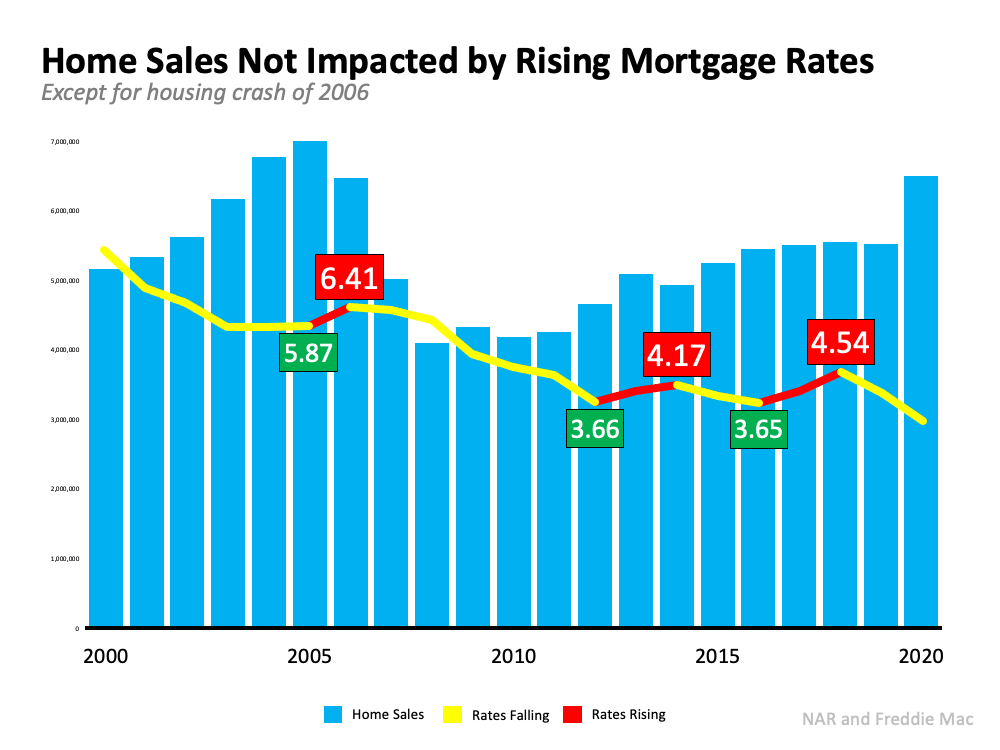 The last three times rates increased (shown in the graph above in red), sales (depicted in blue in the graph) remained rather consistent. It’s true that sales fell rather dramatically from 2007 through 2010, but mortgage rates were also falling at the time. The next two instances showed no meaningful drop in sales.
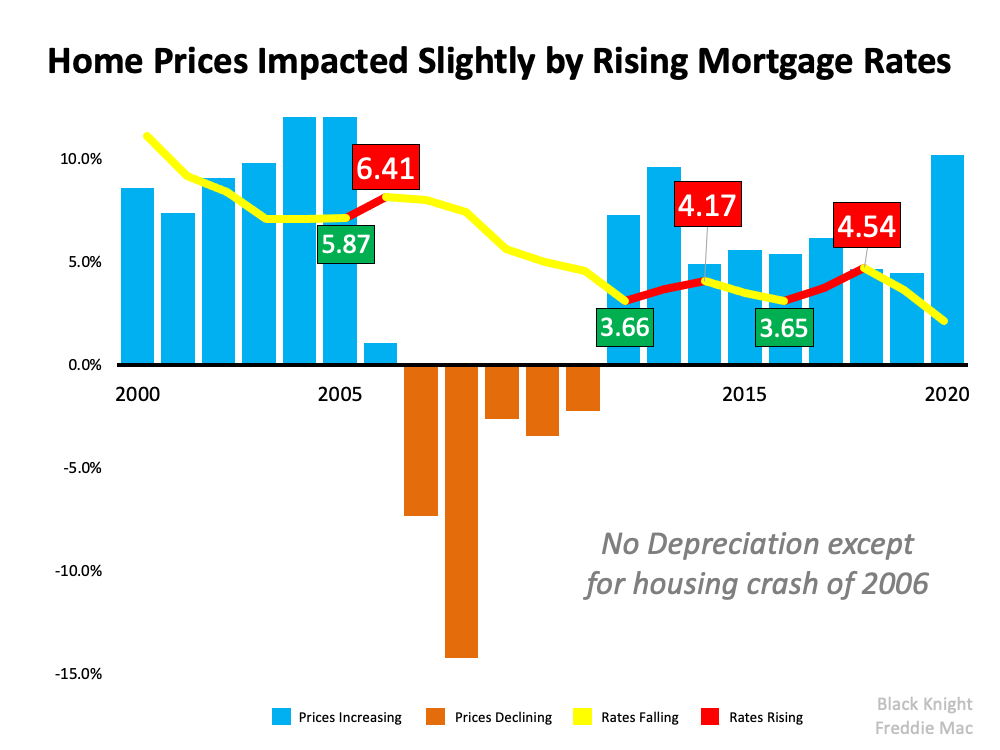 Again, we see that a rise in rates didn’t cause prices to depreciate. Outside of the years following the crash, prices continued to appreciate, just at a slower rate.